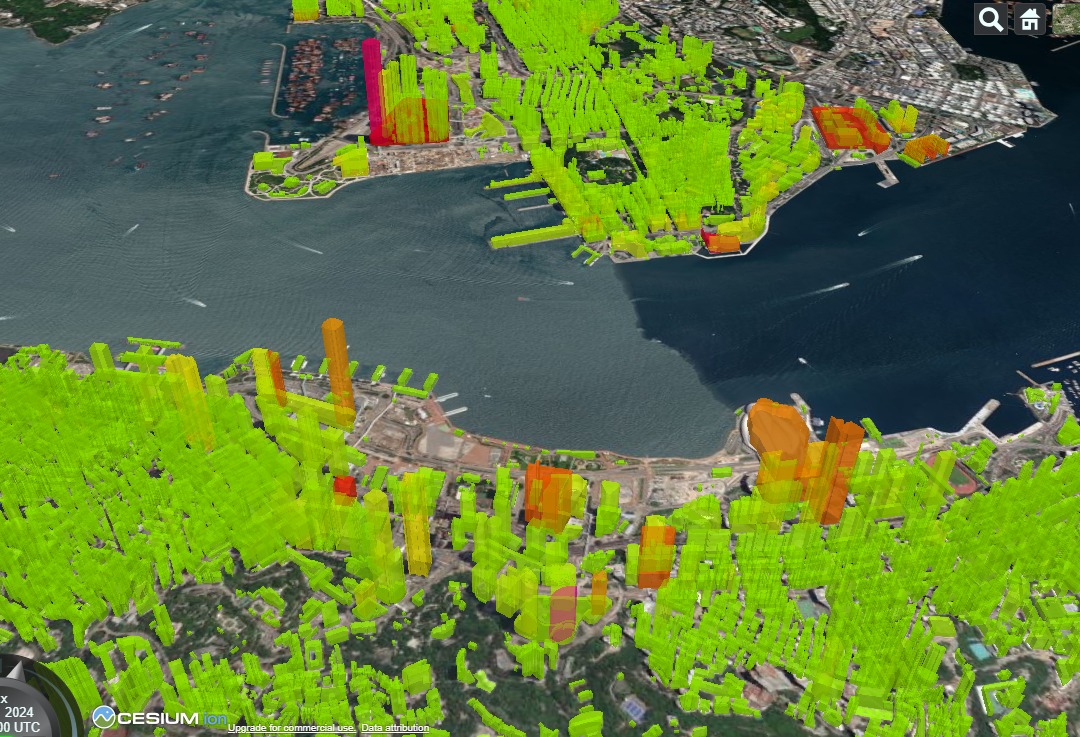
The Urgency: Why Tropical and Urban Cities Are at the Center of Climate Risk
As the planet warms and weather extremes intensify, urban areas are becoming the epicenters of climate impact. Heatwaves, flash floods, and extreme precipitation increasingly threaten cities—particularly in tropical and subtropical regions, where high population density and vulnerable infrastructure compound the risks. Yet, most current weather and climate models are not equipped to capture these dynamics, especially in the tropics.
Limitations of Today’s Weather and Climate Models
Today’s global models are too coarse in resolution and are fundamentally built on physics optimized for mid-latitude systems—regions like the U.S., Europe, Japan, and northern China. Simply increasing resolution, by running models at finer scales, does not solve the problem. Nor does using AI-based downscaling techniques: while these may refine model outputs, they cannot compensate for missing or misrepresented processes in the model’s physical core, such as tropical convection, mesoscale circulation, and urban-atmosphere interactions.
What is urgently needed is not just more computing power, but better science: an overhaul of the underlying model physics to capture land-sea interactions, vertical instability, and two-way feedbacks between urban surfaces and the atmosphere. This is where the HKUST initiative takes a fundamentally different approach.

Why Our Approach Is Different: We Build the Physics, Not Just Run the Models
While many research groups focus on running existing models at higher resolutions—augmenting surface land-use inputs and urban canopy detail—they often do so without improving the physical processes inside the models themselves. In contrast, we are model developers, not just users. Our work involves rebuilding and enhancing the model physics, integrating the processes that are uniquely important in tropical urban environments. This includes capturing localized convective systems, diurnal heat retention and release in dense urban fabrics, and feedback loops between adaptation measures (like green roofs) and hazard profiles. This scientific rigor ensures our predictions are not just sharper—but fundamentally more accurate and relevant to the challenges tropical cities face.